Wednesday, February 9, 2011

Replacing a piece of Dislodged ceramic floor tile.

This triangular piece of floor tile was broken and dislodged from the floor 
Use an A4 paper to mark and cut a template
Mark the shape of the piece of tile
to cut and replace.
One piece of ceramic tile dislodged from the floor. What is your immediate reaction?  Call your “friendly” contractor to fix it. Sounds simple for this simple job. Right? But in reality it is very tough. You may have to call your contractor umpteen times and he still does not show up. Each time his PR response is “ I will call you a day before I come”. The expected visit from him is like waiting to win a lottery.  And if he finally comes, his first suggestion will be “Change all the tiles ah h?” If your response is “one only” He would hesitate and sounds very disappointed. “One only ah h! How much to charge you for this one?” he asked. If the dislodged tile is broken, there will be more problems.

Cut the paper to form the template.
If the contractor is willing to do the small job, the fact remains that he can never get back the same tile, in term of colour and tone. Tile manufacturers can never produce the tile of the same colour and shade for every batch. Even if one goes back to the same manufacturer with the same product code, one can never get a piece of replacement tile of same colour shade. This is the fact one must accept.

Check the template fitting
The contractor has to make a few trips. First trip is to examine the damage and to assess the availability of that particular piece of tile. On the next trip, he has to run to a few shops to source for the tile. If he is lucky, his third trip is to bring his worker to do the job.

Use the template to mark on the tile for cutting.
So, how much do you think he should charge you for that miserable piece of tile replacement?

For that reason, most contractors are reluctant to do tile replacement job, unless one willing to change the entire floor tiles. Moreover, there are many fussy housewives who do not understand and accept this fact.  They will complain and argue with the contractor over the different colour tone and shade.

The replacement tile with marking ready for cutting

A DIY buff will keep all the left over materials from construction or repair jobs. I stored them in the water gutter of the roof. After so many years, I appreciated my own effort.  I have the same tile of the original colour tone/shade to replace the dislodged and broken piece.

Replacing the dislodged tile by DIY can be done quite easily provided you have the right tools and correct cement mixture. 

Tile cutting tool and goggle(for eye protection)
I borrowed a tile-cutting tool from my brother.

Firstly, I marked the shape of the tile to replace, using a piece of A4 paper to cut a template. With the paper template, the cutting line is mark on the tile, to facilitate the precise cutting requirement.
Use a masonry chisel or drill to remove
 the old cement plaster.
Next, I remove the old cement plaster from the floor where the tile was dislodged with a masonry (concrete) chisel. Then, I wash and drain out the debris

After Chiseling and wash up
Cut the tile on ground with grass
to avoid damage tot he cutting disc.
Finally, mix 3/4 portion of cement with 1/4 portion of white lime and a small amount of water. Mix them thoroughly until a sticky paste is achieved.   Apply the mixture on the tile and on the floor. Ensure the required amount of cement mixture is applied to achieve the levelling with the surrounding tiles.   The use of a levelling tool, if necessary to check this. Use a small piece of wood to do the levelling. 


Never use a hammer. You may break the tile.

Mixing the cement into a sticky paste
See the completed job. This is done in two hours.  Let the cement mixture to cure and dry for 24 hours before stepping on the replaced tile.  Keep the tile cool and moist during the curing process by sprinkling some water over the replaced tile after 4 hours.


The replaced tile is similar to
 the surrounding old tiles.
The edge mosaic tiles are also replaced.

Tuesday, December 28, 2010

Motion Sensor Light

This sensor adaptor from " AVA" Taiwan, is fixed to a table lamp
This cost RM55.00.  Just take out the bulb and fix this adaptor into the bulb
holder. Then, fix the bulb on top of the adaptor
.

Do you ever have a strange notion in the midst of sleeping? A state of mind that is vague and  uncertain of oneself.  One is not sure if one is dreaming or in a semi conscious state or is fully awake. I have this experience  whenever I have the urge of easing myself in the middle of the night. Yet, I wasn’t sure if I am in a sub-conscious state of mind, dreaming or actually awake. My hand moves by reflex action to locate the light switch beside the bed. In the darkness, I occasionally push down the alarm clock and the glass ornaments on the side table of the bed.

Close up of the sensor. The red blinking light
indicates motion is detected.
That was history. I have overcame the problem with the PIR Sensor (Passive Infra-Red Motion Sensor) way back in 1988  I bought the first PIR sensor light for RM550 ringgits. This was a proud Malaysian invention by two engineers from Sitiawan.
This is my first Motion Sensor table lamp
purchased in 1988 for RM550.00.
This motion sensor was invented by two Malaysians.

The first generation motion sensor lamp by NOVAL.

Since then, I cannot go on without the PIR sensor light.

This is the second generation sensor lamp by
Noval (Malaysian Invention)
Now, my house is equipped with PIR sensor light in every rooms and at every corners of the house.. I don’t have to  grope in the darkness anymore..  I just simply walk around the house at night  and the light switch on automatically and switch off by itself after the set timing (2 to 15 minutes) expires.

This is a sensor adaptor mounted on a table lamp
This is "AVA" brand sensor made in Taiwan
The cost is RM55.00 
Most PIR motion sensors are also equipped with a photo sensor. The photo sensor can be set to the required degree of brightness or darkness (called LUX) to activate the motion sensor. If one set the LUX to absolute darkness, the motion sensor will only activate and switch on the light when the surrounding is in total darkness and motion is detected.

There is also a built-in timer to set the duration of on/off lighting The motion sensor will switch off the light after the set duration expires, unless further motion is detected.

This "Plug & Play" sensor adaptor fits any standard E27
screw-type bulb holder
Some PIR Motion sensor light are sold in ‘Plug and Play” package. They come in the form of table lamp, stand lamp, wall light and ceiling light. Just plug into a 3-pin socket or connect to AC wire (Live and Nuetral) to operate. One can also purchase the PIR motion sensor gadget separately and  connect to the exiting light fixtures.

The PIR motion sensor light are available at most electrical lighting outlets. The price of this gadget has reduced from RM550 in 1988 to below RM50.00 (made in China) now.
This cost only RM39.00. China-made "Nesly"
wall sensor light.
Real value for money. I put this in my kitchen.


The more advance PIR sensor gadget in USA and EU has a built-in thermal sensor. This more advanced gadget can detect the presence of warm-blooded mammal. This is used to control lighting, heater and air-conditioner in home and office. As long as body heat is detected, the sensor will switch on the appliances or fixtures connected to the sensor.  And of course, this come with a price. 

This is a PIR motion sensor. This can be connected to
any existing light fixture. I fixed this onto one
of my ceiling light in my AV room.
Cost only RM39.00 but DIY to
connect two pairs of wires (L/N)


This gadget is suitable for indoor use only.
The cost ranging from RM39.00 to RM90.00
depending on the brand, PDL, MK, Philips or China made.
What you can see here are all indoor sensor lights. 


See how I fixed the motion sensor to my existing ceiling light.


This is a weather proof outdoor sensor at the car porch


For outdoor use, the sensor light must be weather-proof.  I have outdoor sensor lights at every corner of the house. The light will switch on automatically as I walk in the garden at night and swithc off by itself after the set duration expires.


Another outdoor sensor.


Sunday, September 12, 2010

SWITCH/ 3-PIN SOCKET PROTECTOR

Outdoor water-proof switches
Outdoor water-proof  3-pin socket

Electrical switches and power sockets for outdoor use have to be weather-proof, particularly against natural elements of water and heat. These special switches and sockets cost about RM180.00 each compared to the ordinary ones ranging from RM3.50 to RM6.50.

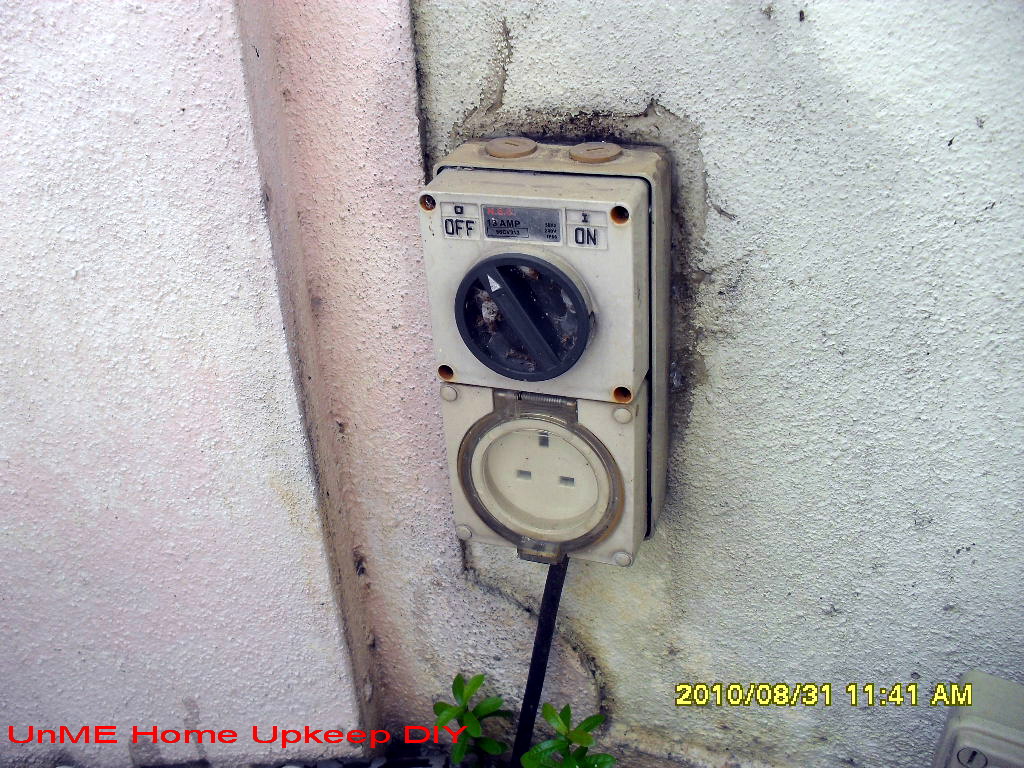
In addition to the weather-proof switches and power sockets for the garden and fish pond, there are a few power sockets on the exterior wall of the building. Although shaded from direct sunlight and rain, they are exposed to rain splashing down on them during thunderstorms. Water then seeps into the socket and over time oxidize the copper element inside, disabling  the electrical contact point.
Outdoor switches for pond fountain pump and lighting.

Switch Protector with the 3-pin socket
A new and cheap gadget is now available. This PVC switch/ 3-Pin socket protector comes in two designs. One is in opaque white and the other comes with transparent cover. The price ranges between RM5.00 to RM13.00, depending on the quality of the PVC material and the brand. 


Spoilt 3-pin Socket.
See the fungus growing on the edges.
To install the switch/socket protector, one needs to unscrew the socket from the wall. For safety reasons, the power supply should be isolated or completely switched off.  
Isolate the electrical power at the MCB
switch board.


Slip the switch protector’s base plate onto the switch and secure the switch with a screw that is ¼ inch longer than the original screw. This is due to the base plate thickness and the soft pad linning . The longer screw is available from any DIY or hardware shop. It costs about 5 to 8 sen each.


No disconnecting of wires is required to install the switch/socket protector.   
See below, the socket protector installed with the 3-pin socket sitting neatly inside.


The flip cover should be closed when the socket is not in use, to prevent water from seeping in.

The spoilt 3-pin socket was replaced with this new socket,
with the socket protecter fitted.

Sunday, September 5, 2010

Harvest Rain Water for cleaning and garden use


There was a huge stack of used plastic containers at the back of my office building. They were used for storing chemicals for the factory use. On closer examination, I discovered the containers were well protected with galvanized iron (GI) cages and pallets.

Each container is equipped with an outlet stop valve and top filling port with a 5-inch diameter cap. The manufacturer of the container is Schutz Container System Incorporated, Lawrenceville, Georgia, USA. I noticed a label – RECYCLABLE CONTAINER.

Existing rain water downpipe
Wow! It’s a dream come true! I have been scouting around for some time for these! What a waste if I do not recycle them. With the help of my colleagues, I brought the container home and connected it to the rain water downpipe. 


nTo complete the pipe connection, five pieces of elbow, one T-joint, 10 feet of 4-inch diameter PVC pipe is required. Since there is no high pressure from the rain water, it is not necessary to seal or glue the joints.


At the outlet valve, a pipe reducer from 2 ¾ inch to ½ inch is connected to facilitate tap fitting and enable the usage of standard garden hose.


Downpipe cut for joining to the 
storage tank port


The total cost of the connection fitting is RM76.00(USD25.00). With this rainwater harvested and collected, I can save RM30.00(USD9.00) per month on my water bill.
Two inlet pipes connected to the
 top filling port holes


Completed connection to downpipe.


Two storage tanks assembled and connected.


Grease the elbow for easy joinning
Outlet valve before fixing the tap connection


Storage tank with outlet tap fitted.


Sunday, July 25, 2010

Modify and Repair Ceiling Exhaust Fan.

One afternoon, my maid came running to me and said “Tuan, itu kipas siling dalam bilik jatuh!” (Sir, the ceiling fan in the room fell).  Instantly, I knew she was referring to the ceiling exhaust fan. I ran up to the room and found the ceiling exhaust fan cover dangling.

I have many fans in the house but only one is the conventional ceiling fan whereas the rest are exhaust fans. An exhaust fan is more effective in ventilating the room.

Most exhaust fans have a cover secured by two pieces of tension springs anchored to the cover plate with a small metal clip and screw. It is designed in such a manner to facilitate easy removal of the cover for regular cleaning as well as cleaning the fan blade and the housing. However, there is one design flaw; the screw and grove are too short and the material too brittle to support the weight of the cover, resulting in the force of pulling, damaging it. The grove that held the screw cracked and then broke off.

How to fix this?  If you call the fan distributor or manufacturer, they will not be able to provide any solution other than replacing the cover. The cover itself cost more than 1/3 the price of a new fan.  Using an industrial glue or a melted glue with a glue gun can provide a temporary solution.  Unfortunately, it will give way after a short period of time.


The best solution, I have discovered, is to modify the way the tension clips are anchored on to  the cover. Drill a hole through the screw grove and use a similar diameter size bolt and nut to secure the tension clip. The required size bolt and nut are easily available from the DIY or your neighborhood hardware shop.  I have a big collection of screws, bolts and nuts of different sizes and shapes in my tool box.

After the modification, this is how my exhaust fan cover looks. It is as aesthetic as the original cover.  Nobody will notice the alteration done to the cover.   It is not conspicuous.  Can you see the modification done?